
 English
 Español
 中文简体
中文简体


Address: No. 199, Weiwu Road, Yueqing Economic Development Zone, Zhejiang Province, China.
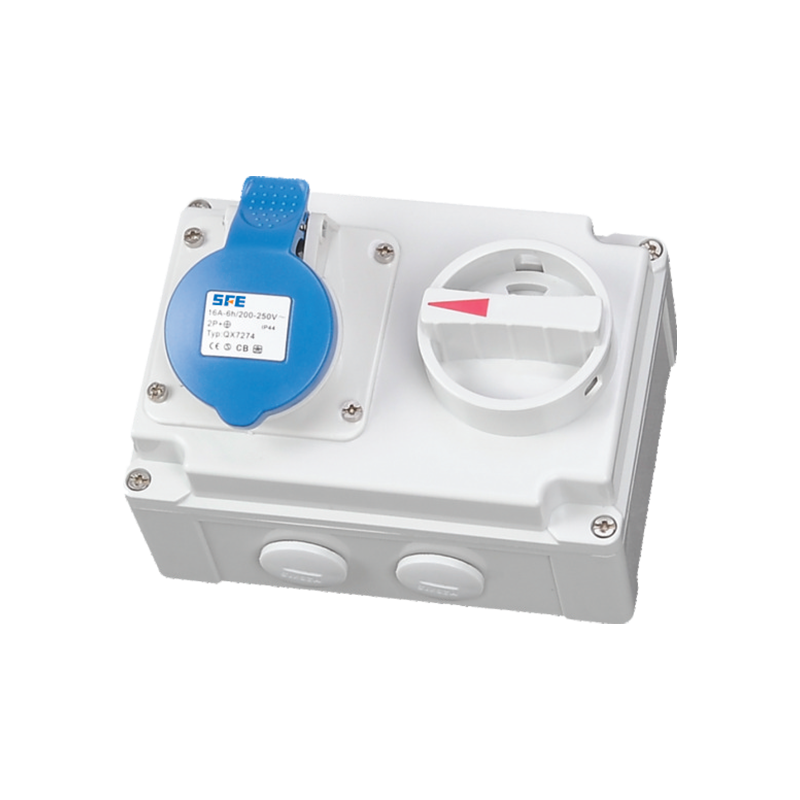
An industrial socket without an interlock is just a live hole. A mechanical interlocking socket adds a physical gate. The switch must be off before the plug moves. The plug must be fully seated before the switch turns on. No software. No sensor. Just a mechanical block.
How the Mechanism Works
A cam, lever, or sliding bolt ties the switch handle to a blocking pin. Turn the switch off, and the pin retracts. The plug can be inserted or removed. Insert the plug fully, and it pushes a trip bar. Only then can the switch turn on. With the switch on, the blocking pin locks the plug in place.
Everything depends on part geometry. If the cam profile wears, the timing drifts. If the trip bar bends, the interlock can be defeated by wiggling the plug. A mechanical interlocking socket needs precise tolerances.
Where the Weak Points Are
The blocking pin takes the most abuse. When someone tries to pull a plug with the switch still on, all the force hits that pin. Mild steel bends. Once bent, it no longer fully engages. The next time, the plug comes out live. A mechanical interlocking socket needs a hardened pin. Ask the factory what steel grade they use.
The trip bar sits deep in the socket where dirt collects. If it seizes, the switch will not turn even with the plug inserted. Operators force the handle and break the mechanism. A sealed trip bar assembly or a self-cleaning guide slot prevents this.
Types of Interlock
- Bolt-type: The switch drives a sliding bolt into a groove on the plug. Simple and common on 63A and 125A sockets. Check that the groove is deep enough.
- Cam-type: A rotating cam captures the plug collar. Smoother operation. Used on higher current sockets.
- Key-release: The switch handle holds a key removable only in the off position. Removing the key releases the plug. Adds lockout-tagout capability.
Auxiliary Contacts
Many mechanical interlocking sockets include an auxiliary contact block. This sends a signal confirming the plug is seated and the interlock is engaged. That signal may enable a contactor upstream. The main power does not flow until the contactor closes, giving a second isolation layer.
Check the timing. Auxiliary contacts must close after the plug is fully seated but before the switch can turn on. If they close early, the control system gets a false positive and may energize a half-inserted plug.
Environmental Sealing
The interlock mechanism has moving parts that need seals. A mechanical interlocking socket rated IP66 or IP67 must keep water out of the mechanism cavity. Water causes corrosion. The trip bar rusts. The blocking pin sticks. The return spring weakens.
Look at the seal points: an O-ring or bellows boot on the switch shaft, a gasket at the plug entry that compresses when seated, a continuous seal on the mechanism cover. Foam strips degrade in UV and are not enough for outdoor use.
Sample Checks
Turn the switch on and off with no plug inserted. The handle should move freely with a definite detent. No grinding.
Insert the plug partway and try to turn the switch. It must be physically blocked. If it moves at all, the interlock is out of adjustment.
Insert the plug fully, turn the switch on, and pull moderately. The plug must not move.
Turn the switch off. The plug should release cleanly. No sticking or wiggling required.
Open the housing. Check the blocking pin for full engagement witness marks. Partial marks mean the pin is too short or the groove is too shallow.
What to Ask the Factory
- What is the hardness specification of the blocking pin?
- How many mechanical operations is the interlock rated for?
- Can you provide a type-test certificate for this model?
- Is the trip bar sealed against dirt?
- Are the auxiliary contacts independently adjustable?
- What is the seal material and its expected UV service life?
A factory that answers these questions directly knows the product. One that deflects to sales talk does not. A mechanical interlocking socket exists to make a dangerous action physically impossible. If the mechanism can be defeated by impatience or a stray kick, it is not doing its job.
